Thursday, 20 September 2018

WWT LWC Barnes with another young birder, 26th July 2018

When I first got Twitter in late February, I wasn't sure what to expect. Gradually, over time, I got to read about more and more birders - I was surprised to find there were more young birders and naturalists than I thought. Though meeting Calum (https://twitter.com/mckellar_calum) at Tring was a bit last minute, I had organised a meetup at the LWC to meet another young, Asian birder Kabir (who recently competed at the Spurn Young Birder of the year award.) This was another good opportunity to meet another like-minded teenager. 
We had picked one of the hottest days of the summer to meet, and it was already stifling by the time we met at the reception at just after 10am. 
After being introduced to each other and introducing family etc, we both headed straight off to the Scrape in pursue of Garganey, which had been reported. It was a lifer for both of us, and I'd dipped it twice already. While en route to the Scrape hide, we saw numerous species like Green Woodpecker, Reed Warbler, Blackcap etc and a nice Emperor Dragonfly or 10. 
From the Scrape hide, there was no sign of Garganey though there were at least 50+ Sand Martin at their nesting bank, largely due to the successful breeding with most of them juveniles. 
We went to the Peacock Tower, but there was very little from there, though a WWT staff member found a Common Sand. A possible juv YLG flew by, but all else was quiet. Then while I scanned a bank on the far side a dark shape blocked my view. Kabir said he saw a green speculum, with white flanks pointing towards Garganey. I didn't see it too well at all, and didn't tick a sighting like that. Another successful dip. 
After thanking the guide Dave, we started to trudge back to the visitor centre, getting stopped by Six-spot Burnets, Blue butterflies, Chiffchaff, Reed Warbler, gulls and really anything that moved.

Once we'd finished lunch, we used the Wildside route to get closer views of some of the butterflies and Common terns - 6 of which were seen, including a very snoozy bird on the Reservoir Lagoon. An ad Snipe dropped down onto the marsh while we were there, and a m Reed Bunting showed briefly. 
Soon after we'd completed the wildside route Kabir (https://twitter.com/Kaulofthewilduk) and his twin Aryan (https://twitter.com/AryanKaul6) and mum left the reserve; it was great to meet them, and pleasing to know that there were numerous young birders in London. 
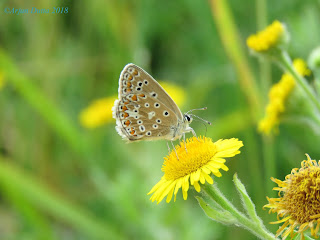
Whilst strolling around the wildside area, waiting for my mum and sister to return, I had a quick search for Small Copper unsuccessfully, though some great views of Common Blue butterfly and Brown Argus, with the addition of numerous dragonfly species.
It was an enjoyable day birding and watching the wildlife, despite the intense heat, limited bird quality and limited time because of it. 

Common Sand digiscope

Sand Martin

Little Grebe


Common Tern
Grey Heron and BHG

the snoozy Common Tern


Forwards

Backwards 
Right


Left
Video


Monday, 17 September 2018

Tring Reservoirs & College Lake with a young birder, 24th July 2018

When my dad said he had work in Buckinghamshire and I had a free day I jumped at the chance to be dropped off at Tring Reservoirs. Even better I asked whether young birder Calum, who lived nearby, was around and he agreed to meet me there.
So at just before 10am my dad drove into the car park, and I was greeted with a slightly crazy-looking, small Scottish boy standing outside of the car, with equipment hanging off him everywhere. It's safe to say he was one of the most friendly, enthusiastic young birders I've ever met...
Either way after my dad and Calum's mum left we walked in, opting to go to the Octagon hide in the centre of the main lake, which is College Lake. While walking down we were stopped by several birds and dragonflies, mostly Red Kites, Reed Warblers and Brown Hawkers. In the hide, with nobody else in there, we spent a good time looking at some of the birds - lots of Lapwing, 2 juv Little Ringed Plover as well as Common Terns and a few other common birds; 3 Little Egrets were also present. Fortunately it was a nice day, and there were plenty of butterflies also out with Small Copper and Common Blue abundant. 
After taking pictures and walking back to the entrance, and watching a Common tern mob a Buzzard, we opted to head across to the nearby Pitstone Quarry to try and find something different. 
When we arrived, there was very little other than the usual Black-headed Gulls and a Lesser Black Backed Gull. With a bit effort we added to our days tally, with Calum's top eyesight picking out another 2 LRP and 3 Oystercatcher (Oiks.) A few Little Grebe were noted, and we tried pathetically hard to find a Med gull, in vain. 
Then we both got an unexpected, mega rarity find along the road - a Red Junglefowl Chicken nearly getting run over. 
Heading back to another hide at College Lake we found quite a few more warblers, as well as a few Brown Argus - first for me - and more Small Copper. Birding wise were 2 possible Garganey that we didn't pay any attention to until one was confirmed 2 days after - typical - and loads more Terns. An adult YLG made a brief appearance before swirling away to the East, and a Chalkhill Blue was also seen. Here are some pictures from the day.


ad Common Tern mobbing C Buzzard 

Lapwing and juv LRP

Green Woodpecker feeding

f Common Blue


juv f Green Woodpecker

3 Little Egret, BHGs and juvs

3 Oiks

f Common Blue

juv BHG

juv Common Terns

One of 2 possible Garganey - this one is a Mallard though

Small Skipper

Brown Argus butterfly
Though I had to leave shortly after, we had a great time birding throughout the morning and early afternoon and I was pleased to meet another, like-minded person of my age. And it wasn't the last I saw of him this summer!

Thursday, 13 September 2018

Bronze DofE: Final Expedition, North Downs.18th-19th July 2018

Having to be at school at 07:30am again after a long two days in France was never going to be easy. Either way I dragged myself in, still armed with my binoculars and camera just as my mum had not recommended. 

For those who read my blog regularly - thank you - you'll know I had a practise expedition in May in the area around Peaslake. This time we were staying in a different area in the North Downs. We started at Farley Green, and the first notable birds were heard here - a party of Crossbill calling. Plenty more Crossbill to come surely. We soon set off in our group of 7 at just before 10am, aiming to cover the 12km across the area all the way to Etherley Copse in 6 hours. For the first half an hour we covered a good 2km, which was a good start. Few birds were about in the gloom, with the best a family of Stonechat. Carrying onwards butterflies started emerging, and a few more birds singing (Marsh and Coal Tit most common.) Time passed and few other birds were seen and heard, only a few Siskin making the list. A few Yellowhammer and Linnet were about, and just a few warblers and firecrests - still can't get enough of Willow Warblers! Besides this very little else was seen for most of the day - after the quality from the practise expedition in May it was very quiet. We arrived at camp at just before 4pm - most of the evening was spent relaxing and laughing at other late groups (including 3 that got lost taking nearly 9 hours.)

After trying to get some sleep, which largely failed with the Tawny owls playing no part in it, my group declared that it would be better to finish as early as possible by leaving as early as possible in the morning. So we left camp at 06:45, aiming to reach the final destination by midday. Just like the day before few birds were seen, though butterflies were in abundance, especially Ringlets. The day continued just like that, and a friend found me a Great-spotted Woodpecker feather to add to my collection (which includes Osprey.) A moment of typical excitement was a redstart-like bird flying across and landing in someone's garden. Alas obviously a Robin. A few whitethroat were around and a single Lesser Whitethroat. A bird I'm still yet to actually see clearly.
Either way it was a fairly enjoyable 2 days walking, with some great views, and memorable experiences. By the time i got back to school I couldn't stop myself sleeping!
Thanks to Robin Stride for tips on what to see and which areas were good for wildlife. Will be helpful in the future as well!

Frog

Marsh Tit - my first picture of one

Ringlet


Monday, 3 September 2018

Battlefields School trip and Birding, 16th-17th July

Due to my cricket season being in full swing most of my spare time in June was spent at my cricket club or school, so very little birding was done. However, there were a few wildlife x cricket moments over the month or two:

June 3: cricket match half a kilometre from Little Woodcote had Chiffchaff, Buzzard and Goldcrest. Bonus was a singing Redstart - unexpected but very pleasing.
June 8: an evening match was tiring. Afterwards while chilling near the bar I spotted a largish group of birds, around 20 strong, heading high N in the fading light. Definitely waders, with the verdict of Dunlin coming that evening.
June 9: at a school match all the crows went up and a large raptor stroked over NW, quite clearly an Osprey. Also seen at Capel that morning.
June 24: an odd day saw autumn start early with raptors coming over our house - 4(!) Red Kites, Buzzards, Sprawks, Peregrine etc.
June 30: school match near the River Thames proved special for butterflies. After my first Silver-washed Fritillary a stunning Purple Emperor swooped amongst a tree I sat under while watching.


Anyway back to the trip. I arrived at school very early on the 16th, sleeping for large amounts of the journey. My coach was going to to learn about the World War I cemeteries in Belgium for the day. The morning was spent in Ypres, where we went into a church and had a speech done for us. After we walked around the town learning about its history. Lunch was distracting as a pair of Reed Warbler sang in a canal, and a few Blackcap sang. I'd like to say I heard a Marsh Warbler, the song is distinctive, but I've got no idea whether they breed in Belgium so didn't tick it.
The rest of the day was quiet birdwise, though all the cemeteries were important and often fascinating to learn about, and I saw few birds but there was the odd thing here and there - Lesser Whitethroat once and numerous Chaffinch, as well as an eagle sp. Roadside fields - if only England was like this still - had Lapwing and even Golden Plover in them. Whilst having dinner I noticed everyone panicking about a large moth, and was pleased/sad to find a slowly deceasing Eyed Hawkmoth. By the time I took it to the entrance it had died sadly.

On Day 2, we started by going to a memorial in France with names of people from our school. Only birds of note were Yellowhammer and f Golden Oriole. We then proceeded on, after lunch, to a battlefield turned memorial-park which played a major part in the first day of the Battle of the Somme. Taking close attention to what our guides said, the only bits I noticed was a Dartford warbler, Whitethroat and hundreds of butterflies that thrived on the wildflowers in the trenches - these included blues, clouded yellows and painted ladys. Whilst driving away, I got an unexpected, pleasant WP tick by way of a Montagu's Harrier over the nearby fields. 

Reed Warbler record shot

Black-tailed Skimmer

Brown Argus -
notice the extra spot on the upper mandible near the head

Painted Lady

Wednesday, 29 August 2018

Morden Hall Park, 2nd June 2018 - Birds, Butterflies, Bats, BioBlitz!

OK I have no idea how I've not done my blog for a couple of months - sorry for my lack of writing and my teenage laziness this holiday! Either way I've got lots to catch up on over the last few busy months so here goes.

On the 2nd June I woke up and went straight to patch for 9am in order to help with the Morden Hall Park BioBlitz 2018. When I arrived, I went for a short walk around the park just to see if anything was around. 2 Reed Warbler were singing when I arrived, and Blackcap and Chiffchaff were singing in numbers. A few dragonfly were on the wing - mostly darters - and Banded Demoiselle were all along the river. When I returned to the stableyard area, I helped out with the birdwalk by the Nature group, led by Nick Rutter. Though few birds of interest were seen other than common birds, a few Greater Spotted Woodpecker were of note. The Reed Warblers didn't show as they normally did but I got a few, dodgy pics. I enjoyed the walk, as I'd never been part of an event like this on my patch. Hopefully I'll lead my own in the future, which would no doubt be helpful to my own knowledge. 

In the evening I returned to the park to help be a part of a bat survey and moth trapping event. As we were given a talk by the Surrey Bat Group, discussing how to use the bat detectors, and distinguishing calls of bats between species - arguably the most interesting part of the day - we didn't start our walk until around 21:15. No bats were heard between the boardwalk and entrance courtyard, as soon as we reached the North Meadows the detectors began beeping loudly to signal Noctules on the wing. As it was dusky, it was hard to see them but they gave some great views overhead. Also detected included Common and Soprano Pippistrelle, Daubentons, Serotine and a single surprise Leislers. Though I had to miss most of the moth trapping because of cricket early next morning, I did see my first Lime Hawkmoth, Poplar Hawkmoth and a few other bits and pieces.
It was an enjoyable day, and I'm hoping to be a part of next years (though GCSEs may get in the way..!)
(All other pics taken with another phone as my phone died!)

Poplar Hawmoth

Reed Warbler

Thursday, 12 July 2018

Thursley Common/NNR - Surrey birding at its best! 27th May 2018

Birding has been pretty dead for me this year with exceptions of the Greece trip and Duke of Edinburgh the weekend before. The only solitary moment of birding joy was hearing a Sedge Warbler singing at my school on the 25th in the morning only. Ridiculous I know.
The last time I went all out birding was Beddington Farmlands in the Beast from the East. So when I somehow convinced my parents that we could do with a walk in the morning and Thursley would be good, and they said yes, I was pretty pleased (though I did go too far with Oare Marshes and even Pagham!) 
I'd only been to Thursley once; that day in 2014 when the Short-toed Eagle made a visit. The most fortunate day of British birding for me. 
We arrived later than we wanted to at 10:30am, and unfortunately it was windy and overcast. We headed out from the Moat Car Park, towards the boardwalk. The very first 2 birds heard were Whitethroat and Woodlark -  a good sign. By 11am, after ambling along, the sun broke through and it became warmer. And the first Stonechats were about finally, along with tons of Lizards basking. An absolutely brilliant Raft Spider sat on the boardwalk as we passed. A decent start, though very few dragonflies were on the wing as of yet. 
We passed the boardwalk, reaching the other side, when I heard the first Dartford Warbler of the day singing momentarily. 
Another 3 pairs of Stonechat appeared, and I finally spotted the first m Redstart perched snoozing on a tree distantly. A pair was then located, just as my mum spotted the Hobby appearing for the hunt, along with a Buzzard. We walked towards the NNR, and I heard the Curlew calling. It was a pleasant sound, that I was thankful to hear as I actually thought they'd left these heath/moorlands. Being Thursley, as soon as the Curlews stopped another pair of Redstart started up and then a Tree Pipit sang for a few minutes distantly. I found the redstarts' nest, before we moved hoping for Colin the Cuckoo. Then I heard and saw the Dartford perched donkeys away, and then again slightly closer. And please enjoy the record shots!
Despite failing with Colin, as we headed back Willow Warblers were among 6 warblers in song at the time, and we watched the Hobby circle Pudmore at 1230ish as it picked up dragonflies. The final species seen were Reed Bunting (my sister found all of them,) some moths and a singing Treecreeper right by the car park. 
Total for the day included 4 Dartford Warbler, 1 Tree Pipit, 2 Curlew, 2 Hobby, 15+ Stonechat, 5-7 Redstart, 2 Willow Warbler min, 2 Treecreeper, 1 Buzzard, 1 Kestrel, 3 Reed Bunting, 6 Whitethroat, 2 Skylark, Woodlark heard only etc. 
A couple of moths seen included the one pictures below, and there were quite a few butterflies on the wing as well.
Speckled Yellow moth
Overall, despite only having 3 hours there rather than a day, it was a very pleasing day in the Surrey heaths - I only wish I could come more like when a bloody Red-backed Shrike is around :)
Here are pictures, mostly poor ones, taken from then.

Raft Spider

Raft Spider

Lizard

Lizard
 And the birds.

fail1: ad m Redstart in flight

Stonechat

ad m Redstart

Tree Pipit


Tree Pipit

RECORD SHOT; first pic of Dartford Warbler

RECORD SHOT; second picture of Dartford warbler

f Stony and Linnet

stare-off Stony

Hobby - always distant

m Reed Bunting

Treecreeper
A mystery bug (for now!)
?
And Pudmore!

Pudmore